
Don’t want to read? Listen to our podcast! Painting without Limits: Episode 2 – All about Watercolour Paper.
Not all watercolor is created equal. I remember when I was first starting out learning how to watercolor paint. I had picked a poor choice of 0% cotton paper to bring to my art class when it was painting a stylized tree all the all my colours were doing we’re turning into mud before my eyes. And this is because the paper didn’t have any cotton. It wasn’t absorbing and letting the paint flow nicely. The waters and paints were just sitting on top of the paper mixing together and making a terrible brown mess. Luckily my art instructor saw my struggles and gave me one of her pieces of watercolor paper. Low and behold my stylized tree turned out perfectly. it wasn’t how I was painting at all, it simply had everything to do with my paper. It was that day that I learned the real power of a good watercolor paper.
It means that you’ll have a more successful painting experience. There are a few different types of watercolor papers hot press cold press and rough press. Hot press is extremely smooth and really great for detail work and for realistic-looking paintings. it’s smooth surface is also great if you’re looking to do pen work on top of your watercolors. cold press paper the most commonly used one has a very slight tooth to it but it is designed for a little bit of texture and for some really great washes. the tiny ripples in the painting allow for the water to pool and sink down this will give you wonderful granular effects especially when you’re working on natural objects. Rough Press Paper has a very ripply rough surface this is even better for extreme textures. Know what kind of painting you want to do first. if you want to work smooth if you want to work with a slight tooth or if you want to work with an extremely rough surface texture. My personal favourite is the cold press paper I just find that it gives the right amount of control where I need it and I do like a tad bit of texture in my work I also love the way that the paints absorb into a great cold press paper.
Next they come in different weights typically 140 lb and 300 lb but they also come in 90 lb and sometimes 260. 90 lb paper is a lot closer to cardstock weight so if you’ve seen a cardstock weight paper night, we’ll be close to that and it’s good for like a few quick washes but not always good for while trying to erase your paper because it can possibly rip through. 140 lb paper offers a great weight and can handle scratching and trying to erase your paints if you’d like. To avoid buckling when you apply water washes I suggest using masking tape to adhere it to a board via putting a border around your paper or stretching it first. And then there’s 260 to 300 lb watercolor paper this will remind you of hard cardboard, it is very thick and it resists buckling. this is a kind of paper that you don’t have to tape down at all but it is a lot more expensive. 90 lb watercolor paper is good for making cards bookmarks and I often use it for swatch cards and then I use the other weights for professional paintings.
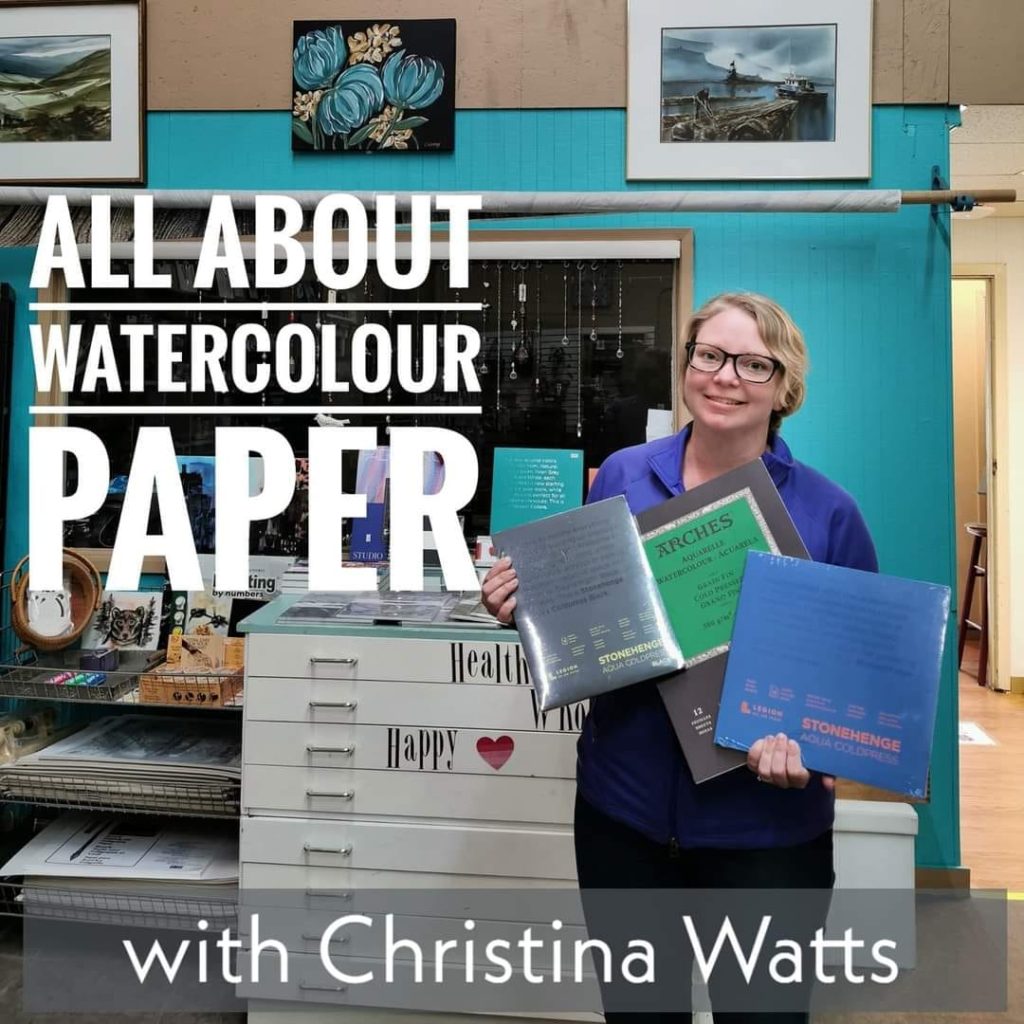
Another critical thing to know about watercolor paper is what it is made out of. The best watercolor papers are made with 100% cotton. Some kinds like studio grade ones can have 25% cotton and they can be okay to learn with. but some watercolor papers don’t have any cotton at all they’re more a blend of cellulose fibres like wood fired or other components that create a more synthetic type of paper. now all of talk to you about a few different types of my favourite brands and what their advantages and disadvantages are. First we will begin with arches paper. this brand has rain champion in the watercolor world for years. It is 100% cotton paper. And it allows for super absorbency a good dry time and your paints will float and blend beautifully. It’s only downfall is that it’s definitely one of the more expensive papers you’ll buy. But it’s so worth it. 140lb 22×30 sheet can cost $14-15 bucks. I also really like Stonehenge Aqua paper. I find that it retains wetness level like no other. It’s dense structure is great for classes because the paper stays wet longer giving the students more opportunity to work with it. It is definitely a softer watercolor paper therefore if your masking or using tape you really need to be careful not to rip it. I also find because it likes to stay wet for so long that you have to really be careful when you’re doing techniques like salting. It’s price is right in the mid-range and a 140lb 22 by 30 sheet will be about $9 bucks Canadian. Another great paper is fabriano artistico now the fabriano artistico is a hundred percent cotton however fabriano also make some other blends for studio-grade. When you feel this paper you can tell that it’s a fairly dry paper it’s definitely trying to be close to arches in terms of dryness level.your paints will float nicely over this paper they do take a little bit longer to absorb into the paper but overall this paper is great for doing things like salting and Saran wrap tricks. Their studio pads with 25% cotton are actually pretty good for a student. The studio grade sheets hundred 140 lb are definitely your cheaper value paper at roughly four to five bucks. The fabriano artistico 140 lb paper is around $9-$10 bucks for a large sheet.
Watercolor paper comes in large sheets that you can cut down to the sizes you would like. it comes in pads of paper so you can peel off a sheet and work on that. And it also comes and things called blocks. blocks are when the watercolor paper is adhered to your pad that means you don’t have to tape it down it is secured to your pad until you use a small knife to unseal the double glued edges. Many people like blocks because there is no taping or stretching involved. In today’s world watercolor paper is also coming and not just white but also black. The difference is with the whites you have to build up your shadows and if you’re using black paper you have to build up the light. That means you need paints that are pigment loaded.